
How Much Do Family Caregivers Get Paid in Massachusetts?

Family caregivers in Massachusetts may be able to receive financial support when they care for an eligible loved one at home. The amount depends on the program, the person’s daily care needs, insurance coverage, living arrangement, and formal approval.
For the broader statewide program overview, including eligibility and how Mass Care Link supports members and caregivers, review our Adult Foster Care in Massachusetts guide.
Quick answer: Through Mass Care Link, an approved family caregiver may receive up to $1,520 per month, based on the member’s assessed needs and MassHealth approval. Payment is not automatic, and the actual amount is determined during the assessment and authorization process.
How Much Can a Family Caregiver Receive Through Mass Care Link?
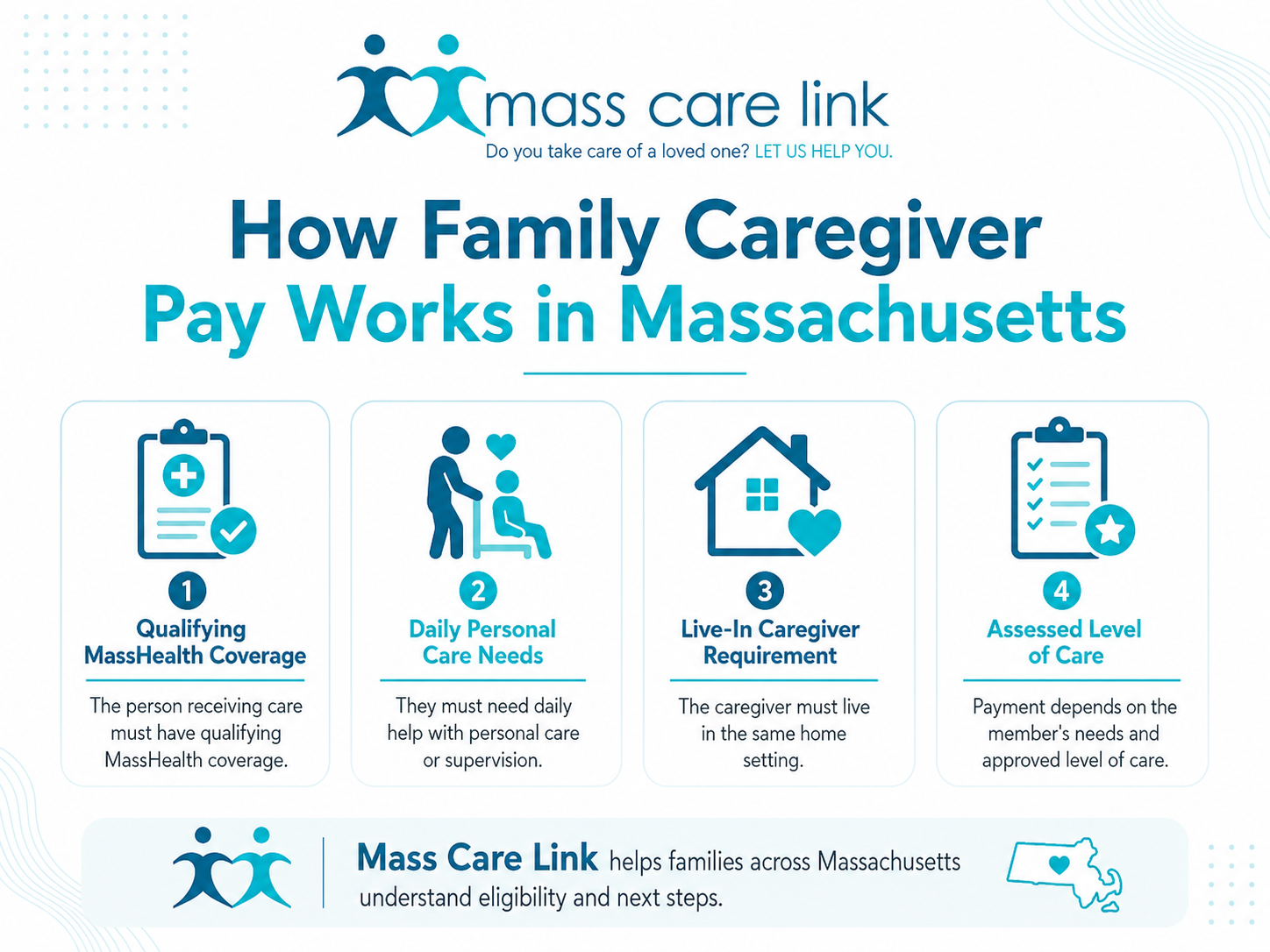
An approved caregiver through Mass Care Link may receive up to $1,520 per month. The payment amount is based on the member’s assessed level of care and MassHealth approval.
Adult Foster Care payments are generally structured as monthly support rather than an hourly wage. A caregiver does not receive more simply because additional hours are reported. The authorized level reflects the type and amount of daily assistance the member requires under the applicable assessment criteria.
Because every case is different, Mass Care Link cannot guarantee a payment amount before reviewing the member’s MassHealth coverage, care needs, caregiver relationship, living arrangement, and required medical information.
What Determines the Caregiver Payment Amount?
The amount is influenced primarily by the member’s documented daily care needs. The assessment considers whether the person requires physical assistance, cueing, supervision, or behavior management with activities of daily living.
Activities of daily living include:
- Bathing
- Dressing
- Eating
- Toileting
- Walking
- Transferring, such as moving between a bed and chair
Basic clinical eligibility generally requires daily physical assistance, or cueing and supervision, with at least one activity of daily living. A higher level of care requires more extensive documented needs under MassHealth criteria. A diagnosis alone does not determine the payment level.
Who Can Qualify as a Paid Family Caregiver?
A family member may potentially qualify when the caregiver:
- Is at least 18 years old
- Lives in the same qualified home as the person receiving care
- Is able to provide the authorized daily assistance safely
- Completes required screening, paperwork, and training
- Participates in scheduled home visits and ongoing oversight
- Follows the approved plan of care and documentation requirements
An adult child, a parent caring for a disabled adult child, sibling, extended relative, or trusted non-relative may be considered when all requirements are met.
A spouse or court-appointed legal guardian cannot be the paid caregiver. A parent cannot receive payment through this program for caring for a child under age 18.
Who Must the Family Caregiver Be Caring For?
The person receiving care generally must:
- Be a Massachusetts resident
- Be at least 16 years old
- Have qualifying MassHealth coverage, generally MassHealth Standard or CommonHealth
- Need daily assistance or supervision with at least one activity of daily living
- Live with the proposed caregiver in a qualified home setting
- Complete the required assessments and medical documentation
- Receive MassHealth authorization before services begin
Someone may have a serious diagnosis or disability but still require an assessment to determine whether the functional and program requirements are satisfied.
Does the Caregiver Have to Live With the Person Receiving Care?
Yes. Under Adult Foster Care requirements, the caregiver and member must live together in the same qualified home setting before services begin.
They may already share a home, the caregiver may move into the member’s home, or the member may move into the caregiver’s home. The residence must be reviewed as part of the application process.
What Does the Caregiver Do in Exchange for the Monthly Payment?
The caregiver provides the daily personal care and supervision identified in the member’s plan of care. Responsibilities may include:
- Helping with bathing, dressing, eating, toileting, walking, or transfers
- Providing cueing and supervision when the member cannot complete tasks safely or consistently
- Following established safety and emergency procedures
- Completing required daily documentation
- Participating in caregiver training
- Being available for nursing and care-management visits
- Reporting hospitalizations, falls, medication changes, and meaningful changes in condition
- Maintaining an appropriate backup-care plan
The caregiver should not provide medical treatment outside the caregiver’s training or role.
What Support Does Mass Care Link Provide?
Caregiver payment is only one component of the program. Mass Care Link also provides:
- Guidance through intake and required paperwork
- Nursing and care-management assessments
- Caregiver education and training
- Development and monitoring of the plan of care
- Regular home visits and professional oversight
- Coordination with healthcare providers and community resources
- Ongoing support when the member’s needs change
This professional structure helps families organize care and maintain required program standards while the member remains in a familiar home setting.
Are Family Caregiver Payments Taxable?
Certain Medicaid waiver payments for care provided in the caregiver’s shared home may qualify for exclusion from federal gross income under IRS Notice 2014-7. However, tax treatment depends on the payment arrangement and the caregiver’s individual circumstances.
Caregivers should not assume that every payment is automatically tax-free. They should review any tax documents received and consult a qualified tax professional about federal and Massachusetts reporting. The IRS provides guidance on certain Medicaid waiver payments.
How Does Adult Foster Care Pay Compare With PCA?
Adult Foster Care and the Personal Care Attendant program are separate MassHealth services.
- Adult Foster Care: Uses a live-in caregiver model, includes nursing and care-management oversight, and generally provides the caregiver with monthly financial support.
- PCA: Generally authorizes a specific number of assistance hours and uses a consumer-employer structure.
The programs generally cannot be used together for the same personal-care needs. Families should compare the care structure, caregiver relationship rules, and member needs instead of choosing based only on the advertised payment.
See our detailed comparison of AFC, GAFC, and PCA programs in Massachusetts.
How to Apply to Become a Paid Family Caregiver
- Complete an intake. Provide basic information about the member, caregiver, MassHealth coverage, and living arrangement.
- Verify coverage. Mass Care Link confirms whether the member has an eligible MassHealth coverage type.
- Complete forms. The member and caregiver submit the required application documents and authorizations.
- Provide medical information. This may include a current physical examination, primary care provider order, diagnoses, and medication information.
- Participate in assessments. Nursing, psychosocial, and qualified-setting assessments review the care needs and home.
- Complete caregiver requirements. The caregiver completes screening, documentation, and training.
- Wait for authorization and placement. Payment cannot begin until the required approval and formal placement are completed.
Review the complete Adult Foster Care application process and our guide explaining how to qualify for services.
Frequently Asked Questions
Can I get paid to care for my elderly parent in Massachusetts?
Potentially. An adult child may be considered as the caregiver when the parent has qualifying MassHealth coverage, needs eligible daily assistance, lives with the caregiver, and receives approval.
Can I get paid to care for my disabled adult child?
Potentially. A parent may be considered as the caregiver when the child is at least 18 and all other requirements are met. A parent cannot be paid through Adult Foster Care for a child under 18.
Can I get paid to care for my spouse?
No. A spouse cannot serve as the paid caregiver under Massachusetts Adult Foster Care requirements.
Can a legal guardian receive the caregiver payment?
No. A court-appointed legal guardian cannot be the paid caregiver.
Does MassHealth pay every family caregiver?
No. The member and caregiver must meet the specific requirements, complete the assessment and application process, and receive authorization.
When does caregiver payment start?
Payment begins according to the provider’s procedures after MassHealth authorization and formal placement. Care provided before enrollment is not automatically payable through the program.
Can I receive PCA and Adult Foster Care payments at the same time?
Generally no. MassHealth restricts duplicative personal-care services. Current programs must be reviewed during intake.
Find Out Whether Your Family May Qualify
If you care for a family member at home in Massachusetts, Mass Care Link can verify the person’s MassHealth coverage and explain the next step. Start an application or call 866-880-8889.
Related guides: Review caregiver compensation programs and eligibility in Massachusetts and learn how to become a paid caregiver in Massachusetts.
This article provides general educational information. Eligibility, payment, authorization, and tax treatment depend on current requirements and individual circumstances.
Official Sources
This article provides general educational information. Eligibility, caregiver approval, payment, and authorization depend on current requirements and individual circumstances.